
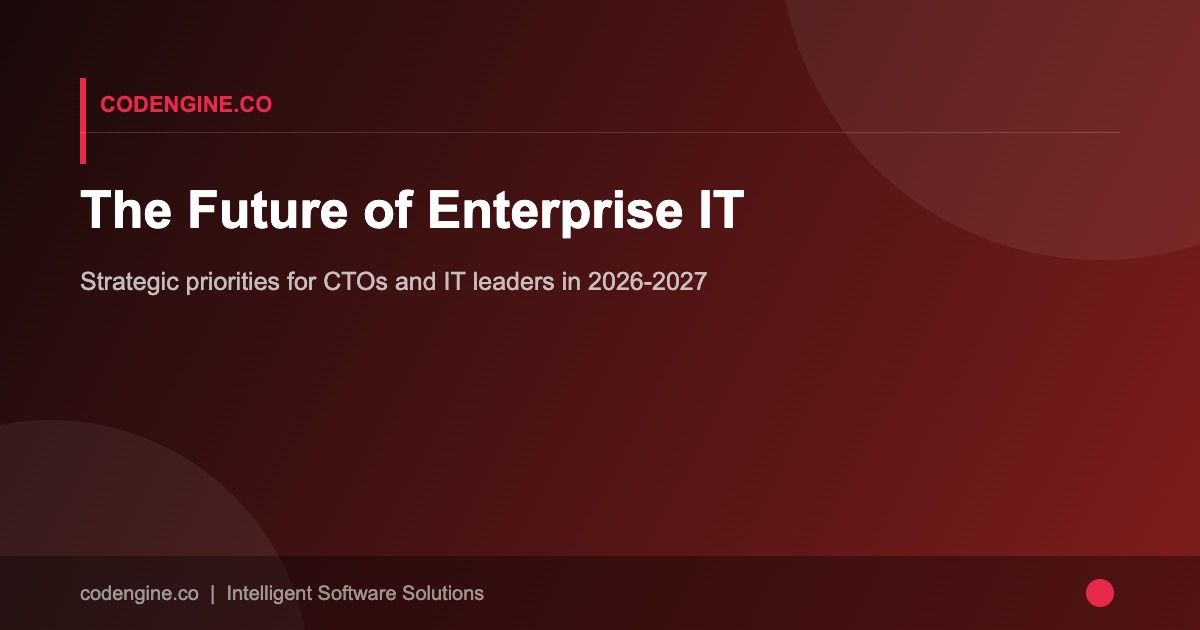
The role of IT leadership has shifted dramatically. Where technology decisions were once largely about infrastructure cost and uptime, today’s CTOs, CIOs, and IT directors are expected to be strategic business partners — responsible for how technology creates competitive advantage, manages risk, and enables growth.
This guide is written for enterprise IT leaders and the business stakeholders who work with them. It focuses not on general technology trends, but on the strategic decisions and organisational challenges that will define effective IT leadership over the next two to three years.
From Cost Centre to Value Driver
The most important shift in enterprise IT thinking over the past decade is the movement from viewing IT as a cost centre to recognising it as a value driver. IT is no longer just infrastructure and support — it is the capability that enables digital products, data-driven decisions, operational efficiency, and customer experience differentiation.
IT leaders who have made this transition successfully share a common characteristic: they speak the language of business outcomes, not technology specifications. They frame investments in terms of revenue enabled, risk reduced, and efficiency gained — not servers provisioned or tickets resolved.
For organisations still treating IT primarily as a cost to be minimised, the competitive disadvantage is becoming increasingly visible. Digital-native competitors with leaner, more adaptable technology stacks can outmanoeuvre incumbents at every level.
The Build vs. Buy Decision in 2026
One of the most consequential decisions enterprise IT leaders face is which capabilities to build, which to buy, and which to outsource. The answer has become more nuanced as the software landscape has matured.
The general principle is to buy commodity capabilities (HR management, payroll, email, basic analytics) and build differentiated capabilities (the workflows, data models, and customer experiences that define your competitive position). The problem is that many organisations have inverted this — they have built expensive, hard-to-maintain custom solutions for commodity functions while using off-the-shelf tools for the capabilities that actually differentiate them.
Reviewing and correcting this alignment is one of the highest-ROI exercises an IT leader can undertake. Strategic IT investment should concentrate on the capabilities your business cannot buy — the proprietary systems, data assets, and digital experiences that competitors cannot simply replicate by purchasing the same SaaS subscription.
Cybersecurity as a Board-Level Priority
Cybersecurity is no longer a technical concern managed within the IT department — it is a board-level risk management priority. Regulatory environments in most jurisdictions now require senior leadership to take direct accountability for cybersecurity posture. The EU’s NIS2 Directive, for example, places explicit personal liability on C-suite executives for cybersecurity failures in critical sectors.
The shift in how enterprise IT leaders need to think about security is significant. Security-by-design — building security into systems from inception rather than retrofitting it — must be a non-negotiable principle for every new technology investment. Zero Trust architecture, in which no user or device is trusted by default regardless of network location, is the accepted standard for enterprise security posture.
Incident response capability is equally important. The question is not whether a significant security incident will occur, but how quickly your organisation can detect, contain, and recover from it. Organisations that have invested in incident response planning and rehearsal consistently outperform those that have not when a real incident occurs.
Cloud Strategy Maturity
The initial wave of cloud adoption was largely about cost reduction and basic infrastructure modernisation. Enterprise IT in 2026 is dealing with a more mature and more complex set of cloud challenges: multi-cloud management, cloud cost governance, data gravity and egress costs, regulatory compliance across cloud jurisdictions, and the build-up of new forms of technical debt in cloud environments.
Cloud FinOps — the practice of applying financial accountability to cloud spending — has become a recognised discipline as organisations discover that cloud costs, without active management, can easily spiral. Establishing cloud cost visibility, accountability, and optimisation practices is a priority for any organisation with meaningful cloud spend.
Multi-cloud strategy requires particular attention. While distributing workloads across multiple cloud providers offers resilience and avoids vendor lock-in, it also introduces management complexity and skills requirements. The decision to go multi-cloud should be driven by genuine business requirements, not by a reflexive desire to avoid dependency on a single vendor.
AI Governance: The IT Leader’s New Responsibility
As AI systems become embedded in business decisions — from customer credit assessments to hiring support to operational prioritisation — IT leaders are increasingly responsible for AI governance: ensuring that AI systems behave as intended, that their decisions can be explained and audited, that they do not perpetuate or amplify bias, and that they comply with emerging regulatory requirements.
The EU AI Act creates a tiered regulatory framework based on risk level. High-risk AI applications — in areas like employment, credit, healthcare, and critical infrastructure — face strict requirements around transparency, human oversight, and documentation. IT leaders deploying AI in these domains need governance frameworks in place now, not when enforcement begins.
The Technology Talent Equation
Access to technology talent remains one of the most significant constraints on enterprise IT ambition. The demand for skilled software engineers, data scientists, cloud architects, and security specialists consistently outpaces supply in most markets. IT leaders are addressing this through several complementary strategies: building deep expertise in a focused set of critical capabilities while sourcing broader skills through trusted technology partners; investing in developer experience to improve retention; and systematically using AI tools to amplify the productivity of existing team members.
Strategic IT outsourcing and staff augmentation — when executed with the right partners — can provide access to specialised skills, accelerate delivery, and manage capacity fluctuations without the overhead of permanent headcount growth.
Conclusion: IT Leadership as Strategic Advantage
The organisations that will lead their industries over the next decade are those where IT leadership is genuinely strategic — where technology investment decisions are made in close alignment with business goals, where security and governance are embedded rather than bolted on, and where technology capabilities are treated as competitive assets to be cultivated and protected.
At CodeNgine, we work alongside IT leaders as a strategic technology partner — from initial advisory and architecture through to custom software development, quality engineering, and ongoing support. Whether you need an experienced partner for a critical development programme or strategic counsel on your technology roadmap, we bring both the technical depth and the business perspective that enterprise IT decisions require.
Explore our IT Consulting and Advisory services or get in touch to discuss your organisation’s technology priorities.